“SERVING YOUR PLATING NEEDS IN THE BEST WAY POSSIBLE”
CAGE CODE: 97F93
(973) 746-1200Electroless Nickel
Electroless Nickel
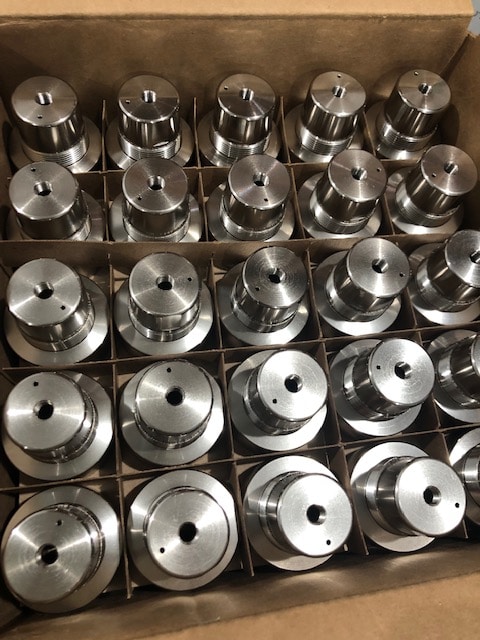
Electroless Nickel Plating (ENP) is the deposit of a nickel-alloy coating by chemical reduction without the electric current that’s used in electroplating processes. The majority of ENP for engineering purposes is a nickel phosphorus deposit containing 2 to 14% phosphorus. The higher the phosphorus content the greater the corrosion resistance, however the compromise on increased phosphorus content is a decrease in hardness. ENP is deposited by reducing nickel ions to metallic nickel with a chemical reducing agent such as sodium hypophosphite. Thickness of between .0002″-.0005″ is common.
This process is excellent for use in applications that require uniform distribution throughout the entire part. It features excellent corrosion resistance, wearability, lubricity and solderability. Parts range from small electronic connectors to machine parts.
The benefits of electroless nickel plating
ENP offers excellent corrosion resistance to common corrodents such as salt water, carbon dioxide, oxygen and hydrogen sulfide. High phosphorus deposits of ENP (10-14% phos) is also amorphous, which means that there are no grain or phase boundaries to create initiation sites for corrosion.
The uniformity of ENP versus electrolytic deposits is also advantageous, creating a uniformly thick coating across the whole substrate; even in slots, holes and inside walls of tubing. Without heat treatment corrosion resistant high phosphorus ENP still provides good hardness and wear resistance properties.
ENP offers a cost-effective solution for applications subject to conditions where wear and corrosion are factors; extending service life and providing a lower cost alternative to corrosion. resistant alloys, particularly where carbon steel suffers localized corrosion; flange attack or weld corrosion.
What are the properties of the deposit and factors affecting them?
ENP offers excellent corrosion protection and uniformity of deposit along with good hardness. The phosphorus content of the deposit can be altered to best fit the application.
The higher the phosphorus content the greater the corrosion resistance but lower the surface hardness. Hardness of ENP can be increased by heat treatment but this produces a microcracked deposit with reduced corrosion resistance. ENP deposits uniformly, even on complex shapes, unlike electroplating.
What is Electroless Nickel Plating Used For?
Electroless Nickel Plating is versatile and offers many advantages. It is used to keep parts protected from natural wear, abrasion and corrosion, and adds hardness to the surface for all types of applications in varying conditions. Electroless Nickel Plating is most used in the following industries:
- Aerospace
- Construction
- Electronics
- Engineering
- Oil & Gas
Examples of industrial parts that can be finished with ENP include drive shafts, electrical and mechanical tools, engineering equipment, oil field valves, valve pumps and more.
Benefits of Electroless Nickel Plating
The Electroless Nickel Plating process offers various advantages over traditional electroplating that make it a reliable surface finishing treatment:
Corrosion Protection
Electroless Nickel Plating is less porous than electroplated nickel, making it extremely hard and corrosion-resistant to common corrosives such as salt water, carbon dioxide, oxygen, and hydrogen sulfide.
Uniformity
The ENP process deposits a very even coating on parts. Due to the auto-catalytic nature of this process, there are no high-current or low-current areas that lead to over- or under-plating of critical areas of your part. Thickness can be tightly controlled for engineered coatings, which are free from edge build up. Even complex geometries can be evenly coated with this process.
Hardness
There are several different types of ENP baths that contain varying levels of phosphorus: low (2-4%), mid (5-9%), and high (10-14%). The decision as to which bath to use depends on the final application. Low phosphorus EN (2-4%) provides the greatest hardness while providing the lowest corrosion protection, and high phosphorus EN (10-14%) provides the greatest corrosion protection while providing the lowest level of hardness. Many customers opt for the mid-level phosphorus (5-9%), which provides the best of both worlds.